no_items_in_cart
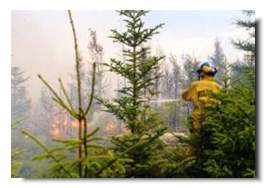
NTRODUCTION
The province of Nova Scotia is responsible for forest fire management on all lands with the exception of Federal and Municipal. Providing the Basic Forest Fire Suppression course is part of that responsibility. The course content provides students with elementary knowledge of all aspects related to fire suppression activities. Normally the course is delivered to students in a classroom followed by a practical session outdoors with working equipment. The material that is covered in the classroom is being offered on line by the Department of Natural Resources in an effort to expedite training requirements.
The objective of the Basic Forest Fire Suppression Course is to provide suppression crew members with the basic forest fire suppression knowledge and skills, to enable them to safely and effectively manage forest fires. This course consists of a theoretical self paced component and a practical session that must be completed in the field with a certified course instructor.
The theoretical portion of the course is offered online as a service to interested participants. The time needed to complete this course will depend on the individuals’ ability; there is no time limit. Please take time to complete the tests following each lesson.
Upon completion of the online portion of the course you will be eligible to make arrangements with a District Office and complete the practical portion of the course. A list of district offices and their contact person is listed in Appendix A. Once arrangements have been made to complete the practical session, you will be required to complete a written test based on the material in this course. This is a multi-choice test, very similar to the tests following each of the six lessons in the course, with a pass mark of 65%. You must pass the test and complete the practical session to receive your certification. If you do not successfully complete the test you will be required to complete the course conducted by an instructor.
Course Structure
The theoretical portion of the course is divided into the following lessons:1. Fireline Organization
2. Fundamentals of Forest Fire Control
3. Effects of Weather, Topography, and Fuels on Fire Behavior
4. Forest Fire Suppression Tools
5. Forest Fire Suppression
6. Personal Safety,
PRACTICIAL PROGRAM
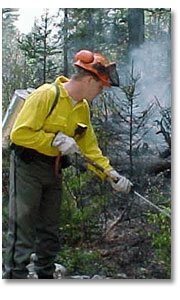
The practical program provides participants with a “hands on” experience in using fire equipment in a safe and effective manner. This portion of the course is delivered at designated Department of Natural Resources Depots.
Candidates must contact their district Department of Natural Resources office to make the necessary arrangements for their participation in the course.
The following components will be covered:
- Pump
- Components
- Set up
- Starting procedure
- Cool down procedure
- Trouble shooting - Tool Box & Hand Tools
- Toolbox contents and uses
- Back Tank demonstration - Hose Handling
- Types of hose and where they apply
- Hose lay systems
- Mop up
- Hose retrieval - Foam
- Handling and safety
- Equipment
- Clean up procedures OBJECTIVES
LESSON 1 - Fireline Organization
- Provide student with an understanding of the Incident Command System
LESSON 2 - Fundamentals of Forest Fire Control
- Ensure that the student has an understanding of the concept of ignition, combustion, heat transfer and how to successfully break the cycle.
LESSON 3 - Effects of Weather, Fuels, and Topography on Fire Behaviour
- Ensure that the student has basic knowledge of the three elements of forest fire behaviour (Weather, Fuels and Topography).
- Provide student with basic understanding of the resulting combustion effects for each element.
LESSON 4 - Forest Fire Suppression Tools
- Provide student with knowledge of tools used in fire suppression activities and how to utilize effectively.
- Ensure that student able to maintain and safely use fire line tools.
LESSON 5 - Forest Fire Suppression
- Recognize fire location terms
- Know the difference between direct and indirect suppression tactics.
- Understand hose handling techniques.
- Are able to perform safe and effective mop up procedures.
LESSON 6 - Personal Safety
- Understands Power Line safety and how to use corrective actions.
- Provide student with basic aircraft safety (fixed wing and rotary wing)
- Provide student with basic heavy equipment safety.
- Ensure student is aware of the use of PPE.
- Understands the concept of LACES and how to apply.
- Provide student with basic knowledge of fire fighter fatigue, proper nutrition, lightning precautions, heat stress, hypothermia and care of feet.
Basic Forest Fire Suppression Course - Online Lessons
PART 1 - Online Program Select your lesson.
Lesson 1 - Fireline Organization
Lesson 2 - Fundamentals of Forest Fire Control
Lesson 3 - Effects of Weather, Topography, and Fuels on Fire Behavior
Lesson 4 - Forest Fire Suppression Tools
Lesson 5 - Forest Fire Suppression
Lesson 6 - Personal Safety
The online component BFFSC consists of a self paced learning program that covers materials presented in the classroom.
The lessons are developed to be followed in sequence., starting with "Fireline Organization". Read each section and the use the link at the bottom of the page to proceed to the next section.
Complete the lesson quiz at the end of the lesson. Once completed, print the quiz results and keep for your records. You will need to hand them into the instructor to be eligible to write the pre-acceptance exam before the practical component of the course.
You may complete the course one lesson at a time. You do not need to log out but you will have to log in again when you return to do the next lesson.